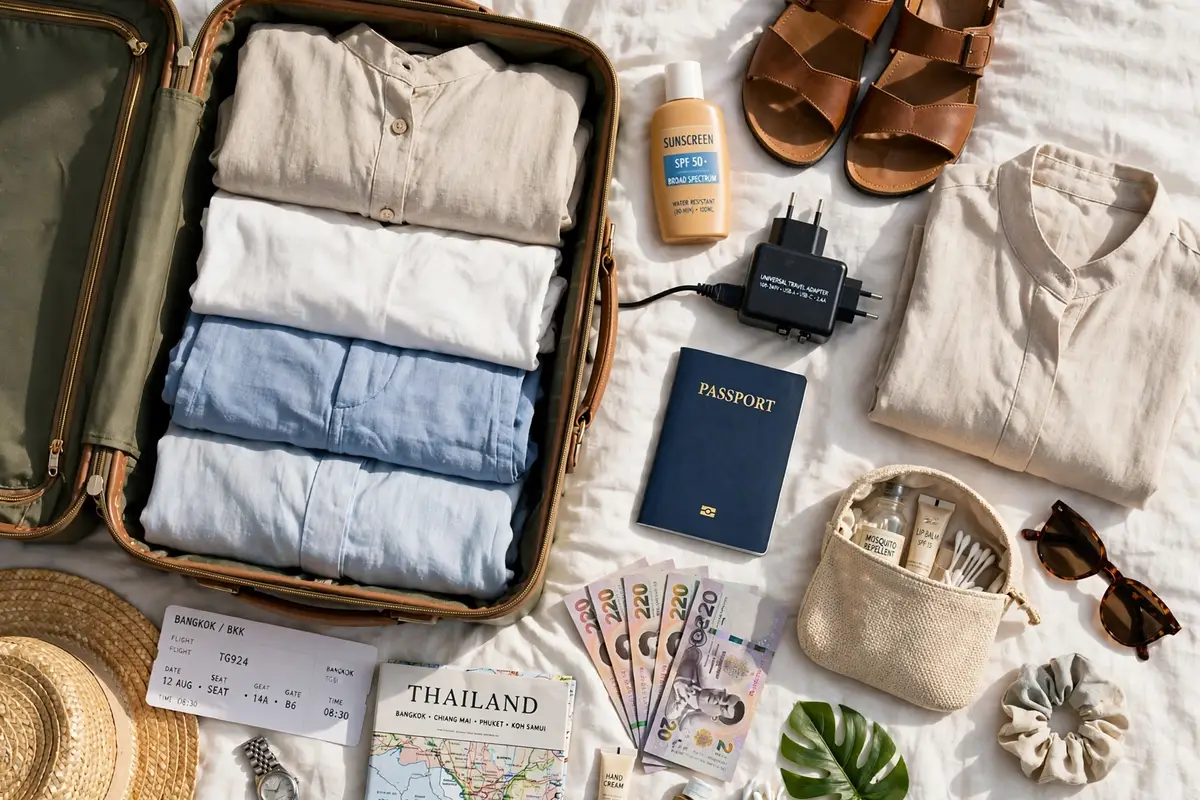
What to pack for Thailand? It is a question that trips up first-time visitors, because Thailand is hot, humid and casual, but it also has temples with strict dress codes, tropical downpours, and island boat trips that punish overpacking. The good news is that Thailand is one of the easiest countries in the world to pack for, because almost anything you forget can be bought cheaply when you arrive.
The golden rule is to pack light. Thailand's shops, markets and 7-Elevens sell almost everything a traveller needs, often for less than it costs at home. A bag you can carry comfortably up a flight of stairs, onto a boat and through a crowded market will make your trip far easier than a suitcase stuffed with "just in case" items you never touch.
This guide covers everything you actually need: documents, clothes, toiletries, health essentials, tech and beach gear, plus the things you should leave at home. It is written for a typical one to two week trip, and it applies whether you are heading for Bangkok, the mountains of Chiang Mai or the islands of the south. For the latest entry and safety rules, check the UK Foreign Office travel advice for Thailand before you fly.
The Packing Philosophy: Light, Breathable, Respectful
Thailand is hot all year round. Daytime temperatures in Bangkok usually sit between 30 and 35 degrees Celsius, and the humidity makes it feel hotter. You will sweat, you will change clothes more often than at home, and you will want fabrics that breathe.
Pack clothes you can wash and dry quickly. Lightweight cotton and linen work well, and modern travel fabrics that wick moisture are even better. Avoid heavy denim, thick jumpers and anything that needs ironing. You will not wear them, and they will take up space and weight you could use for something useful.
Thailand is also a casual country. Most travellers wear shorts, T-shirts and sandals all day, and that is fine in markets, restaurants, beaches and bars. The one exception is temples and royal sites, where covered shoulders and knees are required, so your bag needs at least one outfit that meets those rules. Keep it simple, keep it light, and remember that a laundry service in Thailand costs very little, so you do not need a fresh outfit for every day.
Documents and Money: Pack These First
Your documents are the one thing you cannot buy when you arrive, so sort them before anything else. Start with your passport, which should be valid for at least six months beyond your arrival date. Airlines often enforce this rule strictly, and travellers have been turned away at check-in with less than six months left on their passport. Check the expiry date now, not the night before you fly.
Since 1 May 2025, every foreign visitor to Thailand must complete the Thailand Digital Arrival Card, known as the TDAC, online within 72 hours before arrival. It is free, it replaces the old paper arrival card, and you submit it at the official immigration website, tdac.immigration.go.th. Save the confirmation on your phone and print a copy as a backup. Be careful of copycat websites that charge a fee: the official form costs nothing.
Most visitors from the UK, the EU, the US, Canada, Australia and many other countries can enter Thailand visa-free. As of November 2026, the visa exemption gives most nationalities 30 days, after the earlier 60-day exemption was shortened on 15 September 2026. If you plan to stay longer, sort out your visa before you travel. Visa rules differ from country to country, and our guide to whether US citizens need a visa for Turkey shows how different the requirements can be from one destination to another.
Travel insurance is not legally required for most short tourist visits, but it is strongly recommended. Thai hospitals expect payment for treatment, and an uninsured hospital stay or medical evacuation can cost thousands of pounds. Take out a policy that covers medical care, trip cancellation and your belongings, and keep the policy number and emergency phone number saved on your phone and printed on paper.
For money, bring a debit or credit card with no foreign transaction fees if you can, plus some cash in Thai baht for markets, street food and small shops. ATMs are everywhere in Thailand, but they usually charge a fee of around 200 to 220 baht per withdrawal, so it is cheaper to take out larger amounts less often. Keep your cash, cards and passport in different places, so losing one bag does not leave you with nothing.
Clothes: What to Wear in Thailand
Clothes are where most people overpack, so here is the list that actually works for a one to two week trip.
Pack four or five lightweight T-shirts or tops, in breathable fabrics and light colours. White and pale colours reflect the heat better than black, and they show sweat less. Two or three pairs of shorts are enough, because you can wash them or buy more for very little money in any Thai market.
Pack one pair of lightweight long trousers. You will need them for temple visits, and they are also useful for air-conditioned buses, evening mosquito protection and the cooler mountain air in the north. Linen or light cotton trousers are ideal. A long skirt works just as well if you prefer it.
Pack one modest top with sleeves that cover your shoulders, and one outfit that covers both shoulders and knees. This is your temple outfit. At the Grand Palace and major temples in Bangkok, the dress code is enforced, and visitors in vests, short shorts or see-through clothing are turned away or asked to rent a cover-up. A lightweight shirt and long trousers solve the problem completely.
Add a light rain jacket or a compact waterproof shell, especially if you are travelling between June and October. Thai rain usually falls in short, heavy bursts, and a small jacket keeps you dry without taking up much space. A cheap poncho from a 7-Eleven works just as well and costs almost nothing.
Pack swimwear, at least two sets if you are heading to the islands, because one set will often still be damp when you want to swim again. A sarong is a useful extra: it works as a beach cover-up, a temple cover-up, a towel and a light blanket on cold buses.
For evenings, Thailand is casual. A clean T-shirt and shorts are fine almost everywhere, including most restaurants and bars. If you plan to visit a rooftop bar in Bangkok, pack one smarter outfit, but do not overthink it. A simple shirt and long trousers are enough for anywhere a tourist is likely to go.
Shoes: Two Pairs Are Enough
You only need two pairs of shoes for Thailand. The first is a comfortable pair of sandals or flip-flops, which you will wear most of the time. Thailand is a sandals country, and you will take your shoes off constantly, at temples, in some restaurants, in people's homes and in massage shops, so slip-on footwear saves time and hassle. Choose sandals with a proper sole and some grip, because temple steps and boat decks can be slippery.
The second pair is a comfortable pair of walking shoes or lightweight trainers, for city days, temple visits and any hiking or day trips. Bangkok's pavements are uneven, and a day of sightseeing can easily mean 15,000 steps or more. Break the shoes in before you travel, because blisters on day one will spoil your trip.
Leave the heavy boots, the high heels and the extra pairs at home. You will not wear them, and they are the heaviest things in most suitcases. If you are planning serious jungle trekking, buy or hire suitable footwear locally instead.
Toiletries and Health: The Essentials
Thailand's heat, sun and mosquitoes mean your toiletries bag matters more than it does on most trips. Start with sunscreen, and choose it carefully, because Thailand has a rule that catches many visitors out.
Sunscreens containing oxybenzone, octinoxate, 4-methylbenzylidene camphor (4-MBC) or butylparaben are banned inside Thailand's marine national parks, under a rule in force since August 2021. The fine for using them in a park can be up to 100,000 baht. The ban covers most of the places island boat trips visit, including the Phi Phi Islands, the Similan Islands and Phang Nga Bay. Pack a mineral sunscreen based on zinc oxide or titanium dioxide instead, and check the ingredient list on the back of the bottle, not the "reef safe" claim on the front, which is marketing rather than a guarantee.
Bring insect repellent with DEET or picaridin, because mosquitoes are common, especially at dawn and dusk and in rural areas. Dengue fever is present in Thailand, and there is no vaccine for most travellers, so repellent and covering up in the evenings are your main protection. A small bottle of repellent is enough to start, and you can buy more locally.
Pack any prescription medication you need in its original packaging, with a copy of your prescription, and carry it in your hand luggage. Bring a small first aid kit with plasters, antiseptic, painkillers, rehydration salts and anti-diarrhoea tablets. Pharmacies in Thailand are well stocked and cheap, so you do not need to bring a full medicine cabinet, but having the basics on hand for the first day is sensible.
Do not drink the tap water in Thailand. Bottled water is cheap and available everywhere, and most hotels provide it free. Pack a reusable water bottle to refill from large bottles, which saves money and plastic. A small packet of tissues and hand sanitiser is useful, because some public toilets do not provide paper.
Tech: Adapters, Power Banks and Phones
Thailand's electricity runs at 220 volts and 50 hertz, and the sockets accept plug types A, B, C and O. The Thai national standard is type O, with three round pins, but most sockets are hybrids that also accept the flat two-pin US plugs and the round two-pin European plugs. UK and Australian travellers will need an adapter, while most US and European two-pin chargers fit directly. A small universal adapter covers every case and costs very little.
Check the label on each charger before you plug it in. Most modern phone, laptop and camera chargers are marked 100 to 240 volts and work anywhere with just a plug adapter. Appliances that heat up, such as hair dryers and straighteners, are the danger: a 110-volt-only hair dryer plugged into a 220-volt socket will burn out in seconds. Either leave it at home or buy a cheap one locally.
Power banks must go in your carry-on bag, never in checked luggage, because of airline safety rules. You can carry power banks up to 100 watt-hours, about 27,000 milliamp-hours, without approval, and some airlines allow up to 160 watt-hours with permission. Charging or using a power bank during the flight is not allowed on many airlines, so charge your devices before you board.
Your phone is your most useful travel tool in Thailand. Download offline maps, a translation app and a ride-hailing app before you leave. A local SIM card or eSIM is cheap and easy to buy at the airport or any 7-Eleven, and it gives you data for maps, bookings and messaging. Keep your phone in a waterproof pouch on boat trips, because a wet phone is the most common travel casualty in Thailand.
Pack a small day bag or dry bag for island days. A waterproof pouch for your phone, a dry bag for your camera and wallet, and a light backpack for day trips will cover most situations. A padlock for your bag is useful for overnight trains and shared hostel rooms.
Beach and Island Gear
If you are heading to the islands, a few extra items make the trip much better. A rash vest or UV-protective swim top is worth packing, because it protects you from the sun far better than sunscreen alone, and it means you use less sunscreen in the sea. A snorkel mask is useful if you plan to snorkel, though most boat trips provide one.
A microfibre travel towel is light, dries quickly and takes up almost no space. Most hotels provide towels, but a travel towel is useful for beach days and boat trips. A waterproof phone pouch is essential, and a small dry bag keeps your valuables safe on long-tail boats, where spray is guaranteed.
Leave the bulky beach gear at home. Umbrellas, beach mats and inflatables can be hired or bought cheaply on any Thai beach, and carrying them around is not worth the effort.
What to Pack for Thailand in Your Hand Luggage
Your hand luggage deserves its own thought, because it is what you have if your checked bag is delayed. Pack your passport, your TDAC confirmation, your insurance details, your phone and charger, your medication, a change of clothes, your toothbrush and anything valuable. If you are travelling with a power bank, it must be in your hand luggage by law.
A change of clothes in your hand luggage also matters because Thailand is hot the moment you step off the plane. After a long flight, being able to change into a fresh T-shirt before you reach your hotel is a small luxury that makes a big difference.
What NOT to Pack
Some things are better left at home. Do not pack expensive jewellery or anything you would be upset to lose. Do not pack more than one guidebook, because your phone does the job better. Do not pack a hair dryer unless it is dual voltage, and do not pack heavy toiletries, because Thai shops sell everything, often for less.
Do not pack anything that could cause trouble at customs. Thailand has strict drug laws, with severe penalties, and some medications that are legal at home need a permit in Thailand, so check before you travel if you take anything unusual. Do not bring e-cigarettes or vapes, because they are banned in Thailand and can be confiscated, with fines possible. Check the current rules before you fly.
Do not pack a huge suitcase. A carry-on-sized bag or a medium backpack is enough for one to two weeks in Thailand, and it makes every transfer, ferry and tuk-tuk ride easier. If you can carry your bag up three flights of stairs without help, you have packed the right amount.
The Complete Packing Checklist
Here is the full list in one place, so you can tick it off before you go.
Documents and money: passport with six months validity, TDAC confirmation, travel insurance details, flight and hotel bookings, debit and credit cards, some Thai baht in cash, a copy of your prescription if you take medication.
Clothes: four to five lightweight T-shirts, two to three pairs of shorts, one pair of long trousers, one top with sleeves, one temple outfit covering shoulders and knees, a light rain jacket, two sets of swimwear, a sarong, underwear and socks for the trip, one smarter outfit for evenings in Bangkok.
Shoes: sandals or flip-flops, and one pair of comfortable walking shoes.
Toiletries and health: mineral sunscreen without oxybenzone, octinoxate, 4-MBC or butylparaben, insect repellent, prescription medication, a small first aid kit, rehydration salts, tissues and hand sanitiser, a reusable water bottle.
Tech: a universal power adapter, chargers and cables, a power bank in your hand luggage, a waterproof phone pouch, a local SIM or eSIM, offline maps and translation apps.
Beach and island gear: a rash vest, a microfibre travel towel, a dry bag, a small day backpack, a padlock.
That is everything you need for a one to two week trip to Thailand. Anything else, you can buy when you arrive, and you probably will. Thai markets are half the fun, and a shirt you buy in Bangkok will be a better souvenir than anything you packed at home.
A trip to Thailand is also a great trip to write about, and if you want to keep a record of it, our guide to how to start a journal will help you capture the details that photographs miss. For a slow day on the water, a practical fishing guide for the Gulf coast shows how to make the most of a day by the sea.
Frequently Asked Questions
What to pack for Thailand for 2 weeks?
Pack light: four to five T-shirts, two to three pairs of shorts, one pair of long trousers, a temple outfit covering shoulders and knees, a rain jacket, two sets of swimwear, sandals and walking shoes. Add mineral sunscreen, insect repellent, a universal adapter and a power bank in your hand luggage. Laundry is cheap in Thailand, so you do not need a fresh outfit for every day.
What should I wear to temples in Thailand?
Cover your shoulders and your knees. A T-shirt with sleeves and long trousers or a long skirt is fine. Vests, short shorts and see-through clothing are not allowed at major temples such as the Grand Palace and Wat Pho, and you may be turned away or asked to rent a cover-up.
What plug adapter do I need for Thailand?
Thailand uses 220 volts at 50 hertz, with plug types A, B, C and O. US and European two-pin plugs usually fit Thai sockets directly. UK and Australian plugs need an adapter, so a small universal travel adapter is the safest choice. Check that your devices are marked 100 to 240 volts before you plug them in.
Can I take a power bank to Thailand?
Yes, but it must go in your carry-on bag, never in checked luggage. Power banks up to 100 watt-hours, about 27,000 milliamp-hours, are allowed without approval. Charging or using a power bank during the flight is not allowed on many airlines.
Is sunscreen banned in Thailand?
Some sunscreen chemicals are banned inside Thailand's marine national parks, not across the whole country. Sunscreens containing oxybenzone, octinoxate, 4-MBC or butylparaben are banned in the parks, with a fine of up to 100,000 baht. Pack a mineral sunscreen based on zinc oxide or titanium dioxide instead.
Do I need a visa for Thailand?
Most visitors from the UK, EU, US, Canada and Australia can enter visa-free. As of November 2026, the visa exemption gives most nationalities 30 days. All foreign visitors must also complete the free Thailand Digital Arrival Card online within 72 hours before arrival, and your passport should be valid for at least six months.
What should I not pack for Thailand?
Leave heavy boots, high heels, expensive jewellery, a hair dryer that is not dual voltage, and bulky beach gear at home. Do not bring e-cigarettes or vapes, which are banned in Thailand, and check the rules before bringing any unusual medication. Pack light and buy what you need when you arrive.
You May Also Read
- How Many Days in Bangkok Is Enough? A First-Timer's Guide
- Cheapest Month to Visit Bali: February and the Best-Value Alternatives
- What to Pack for Bali: The Complete Packing List for 2026–27
- Cheapest Month to Visit Thailand: September, Best Value and Where to Go
- How Many Days in Thailand Is Enough? A First-Timer's Guide
- Best Time to Visit Georgia Country: Month-by-Month Guide
- How Many Days in Georgia Is Enough? The Honest Answer by Trip Type
- How Many Days in Vietnam Is Enough? A First-Timer's Guide