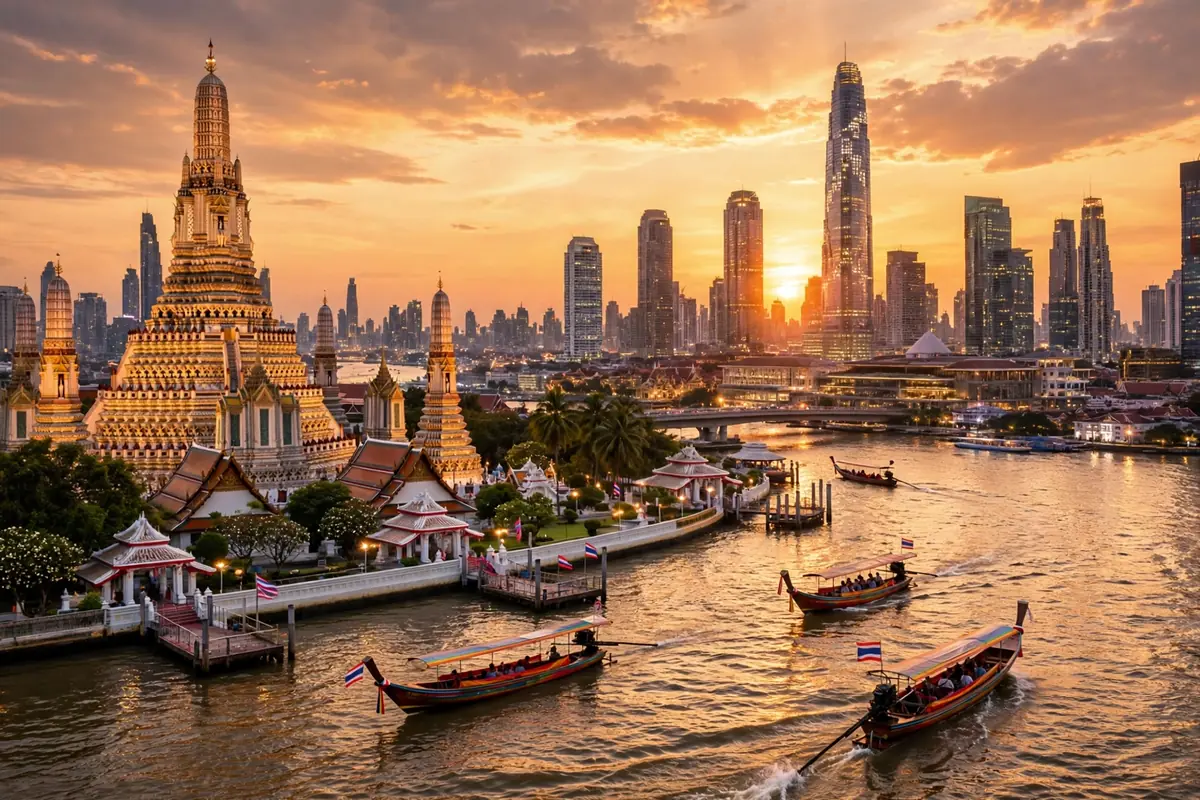
If you are planning your first trip to Thailand’s capital, the question of how many days in bangkok is enough comes up before almost anything else. It decides your flights, your hotel nights and whether you squeeze in a day trip or not. The honest answer is reassuringly simple: three to four days is enough for a first visit. Three days covers the essential temples, the markets, Chinatown and the modern city. Four days lets you do all of that at a relaxed pace, with a proper market morning, a rooftop evening and time to recover from the heat.
Bangkok is a big, hot, loud city, and it rewards a little planning. The traffic is slow, the midday sun is fierce, and the distances between neighbourhoods are larger than they look on a map. Travellers who try to see everything in two days usually end up exhausted and remember the queues more than the city. Travellers who stay a week without a plan can drift and wonder where the time went. This guide breaks down what each trip length actually gets you, so you can pick the number of days that fits the trip you want.
How Many Days in Bangkok Is Enough for a First Visit?
For most first-time visitors, how many days in bangkok is enough has the same answer across almost every guide written about the city: three days is the minimum for a proper visit, and four days is the sweet spot. One recent survey of 17 travel guides found that 11 of them recommended three days for a first visit and four recommended four days. The pattern behind those numbers is consistent. Day one is the old city temples. Day two is markets, old streets and Chinatown. Day three is modern Bangkok: malls, parks, a rooftop bar and a neighbourhood you choose for yourself. A fourth day is almost always spent outside the city, on a day trip to Ayutthaya or the floating and railway markets, or simply slowing everything down.
That does not mean shorter trips are wasted. One day in Bangkok is a genuine experience if it is all you have, and two days can cover the highlights. It means you should know what you are trading away. With fewer days, you trade depth for breadth: you will see the famous sights but you will not have time to wander a neighbourhood, sit in a park, or return to a food stall you liked. With more days, you trade a little money and holiday time for the version of Bangkok that locals actually live in. Whatever length you choose, check the UK Foreign Office’s travel advice for Thailand before you book, since entry rules and safety guidance can change.
What One Day in Bangkok Gets You
One day is a layover, not a visit, but it can still be a great day. Start early at the Grand Palace, which is open daily from 08:30 to 16:30, with tickets at 500 baht sold until 15:30, as of November 2026. Go first, before the heat and the tour groups build up. Walk the short distance to Wat Pho to see the Reclining Buddha, then cross the river to Wat Arun, whose porcelain-covered spires are the classic Bangkok photograph. That is the royal temple trio, and it fills a morning.
Spend the afternoon on the river. A Chao Phraya express boat ride costs very little and shows you the city from the water, past temples, wooden houses and riverside hotels. Finish the day in Chinatown, where Yaowarat Road comes alive after dark with street food stalls, neon signs and crowds. One day gives you the postcard version of Bangkok. It does not give you a market morning, a neighbourhood, a cooking class or a day trip, and you will go home knowing you only scratched the surface.
What Two Days in Bangkok Gets You
Two days is the minimum most guides call a real visit, and it works if Bangkok is a stopover on a longer Thailand trip. Day one is the temple sprint described above. Day two is where the city starts to win people over: pick one neighbourhood and live in it for a day. Ride the BTS Skytrain to Ari for calm cafes and leafy streets, or spend the day around Chinatown, Song Wat Road and Talat Noi, where old shophouses hide some of the city’s best coffee, before Yaowarat takes over after dark.
With two days you can also add one evening experience properly: a rooftop bar at sunset, a night market, or a Thai massage after a long day of walking. What you still miss is the market day and the day trip. Chatuchak Weekend Market alone can swallow a whole morning, and Ayutthaya needs a full day. If you only have two days, accept that and enjoy the city centre rather than racing to fit in a day trip as well.
The Three-Day Plan: The Classic First Visit
Three days is the answer most guides give, and the days split much the same way in guide after guide. This is the plan to follow if you want the standard first-timer trip done well.
Day one is the old city. Start at the Grand Palace and Wat Pho in the morning, cross to Wat Arun, and take a river boat in the afternoon. Dress modestly for the temples: shoulders and knees covered, no exceptions. Bring water, sunscreen and a hat, because there is very little shade around the palace grounds and the heat builds fast.
Day two is markets and old streets. If it is a weekend, Chatuchak Weekend Market is the most famous option: thousands of stalls selling clothes, crafts, food and almost anything else. On a weekday, try a morning market instead, then walk the old streets of Chinatown and Talat Noi. In the evening, eat your way along Yaowarat Road. This is the day for street food, so come hungry and try the small stalls with queues of locals rather than the restaurants with picture menus aimed at tourists.
Day three is modern Bangkok. Start around Siam, with its malls and the Jim Thompson House, a beautiful traditional Thai house and museum. Spend the late afternoon in Lumpini Park, where locals jog, practise tai chi and feed the monitor lizards that live in the ponds. Finish with a rooftop bar or a night market, and you have covered the three faces of the city: royal, old and modern.
What a Fourth Day Adds
A fourth day is the difference between a good trip and a relaxed one. It is the day most first-timers say they wished they had. You can use it in one of two ways, and both are good choices.
The first option is a day trip. Ayutthaya, the old royal capital about an hour and a half north of Bangkok, is the most popular choice: ruined temples and palaces spread across a historic park, easily done as a guided tour or by train and bicycle. The other classic day trip is the floating and railway markets: Damnoen Saduak floating market in the morning, then Maeklong Railway Market, where stallholders fold back their awnings as a train passes through the middle of the market several times a day. Either trip fills a full day and gives you a completely different side of Thailand.
The second option is to stay in the city and slow down. Add a proper market morning at Chatuchak if your trip falls on a weekend, take a Thai cooking class, book a long massage, or spend a morning in a neighbourhood you have not seen yet, such as Thonburi across the river or the creative streets of Charoen Krung. A slow fourth day also builds in a buffer for the heat, which is the single biggest reason first-timers run out of energy. Bangkok rewards travellers who rest in the middle of the day and go out again in the late afternoon, when the light softens and the city cools slightly.
Five Days or More: When Bangkok Becomes a Base
Five days lets you do both: a day trip and a slow day. Add a cooking class, a second neighbourhood, or a second day trip to Kanchanaburi, with its Second World War history and the Bridge over the River Kwai. With a week or more, you can live like a local for a while: morning markets, a favourite noodle stall, a park routine, and day trips to Amphawa floating market or the jungle island of Bang Krachao, a car-free green loop just across the river from the city centre.
There is a point of diminishing returns, though. Bangkok is best as part of a Thailand trip, not the whole trip. After five or six days, most first-timers are ready for the islands in the south or the mountains and temples of the north. If you have a week in Thailand, three or four days in Bangkok and the rest elsewhere is a better split than seven days in the capital. Before you plan the rest of your trip, it is worth checking the entry rules for any other country on your route, since they change often. Our guides to whether US citizens need a visa for Turkey and whether US citizens need a visa for Albania show how quickly visa rules can move, and Thailand is no exception.
When Is the Best Time to Visit Bangkok?
The best months to visit Bangkok are November to February, the cool, dry season. Temperatures are still warm, usually in the high twenties to low thirties Celsius, but the humidity drops and the rain mostly stops. This is also peak season, so hotels cost more and the Grand Palace is at its busiest. March to May is the hot season, when temperatures can push past 35 degrees and sightseeing in the middle of the day becomes genuinely hard work. June to October is the rainy season, with short, heavy afternoon downpours that rarely last all day but can flood streets quickly.
If you can choose, aim for November or February: the edges of the cool season, with good weather and slightly fewer crowds than December and January. If you are travelling in the hot or rainy season, plan your days around the weather. Do temples and walking in the early morning, rest or visit a mall or museum in the middle of the day, and go out again after 4pm. That rhythm matters more than the month you pick.
Where to Stay in Bangkok
Where you stay matters more in Bangkok than in most cities, because traffic can turn a short distance into an hour-long journey. The single most important thing is to stay a short walk from a BTS Skytrain or MRT metro station. That one choice saves you hours over a trip.
Sukhumvit, around Asok to Phrom Phong, is the best all-rounder for first-timers: food, nightlife, malls and easy airport access, with both BTS and MRT lines meeting at Asok. Siam is best for shopping and central sightseeing. Silom is good for food and nightlife and is close to the river. The riverside and the old city around Khao San Road suit travellers who want to be near the temples, but the area is less well connected by train, so expect more taxis and tuk-tuks. Whatever area you choose, check the nearest station on a map before you book, not just the neighbourhood name.
Entry Rules, Money and Getting Around as of November 2026
Entry rules for Thailand changed recently, so check them before you travel rather than relying on an old blog post. As of November 2026, passport holders from 60 countries and territories, including the US, UK, EU states, Canada, Australia, Japan and India, get 30 days visa-free for tourism on arrival. That is down from the 60 days granted between July 2024 and September 2026, when the rule changed on 15 September 2026. You can extend a stay once, for 30 more days, at an immigration office for 1,900 baht. Your passport must be valid for at least six months after your arrival date.
Everyone arriving in Thailand, including visa-free travellers and children, must also file the free Thailand Digital Arrival Card, known as the TDAC, online within three days before arrival at the official government site. It replaced the old paper arrival card in May 2025. Only use the official government portal, since lookalike sites charge a fee for a form that is free. For the latest safety and entry information, read the UK Foreign Office’s travel advice for Thailand before you go.
For money, Thailand is still largely a cash economy at street level. Markets, food stalls, taxis and small shops often take cash only, so carry Thai baht in small notes. ATMs charge a withdrawal fee, usually around 220 baht per transaction, so taking out larger amounts less often saves money. Cards are widely accepted in malls, hotels and larger restaurants. For getting around, the BTS and MRT are fast, cheap and air-conditioned, and they are the best way to cross the city. Taxis are cheap but slow in traffic, so insist on the meter. Tuk-tuks are fun for short rides but agree the price before you get in. Ride-hailing apps work well and remove the haggling entirely.
Common Mistakes First-Timers Make
The most common mistake is trying to see too much in too little time. Bangkok’s sights are spread out, the heat is draining, and a day with five attractions on the list usually ends with three done badly and two skipped. Plan two or three main things per day and leave gaps. The gaps are where the good meals and accidental discoveries happen.
The second mistake is ignoring the heat. Drink water constantly, wear a hat, use sunscreen, and rest in the shade or indoors during the hottest hours. Heat exhaustion is the most common reason first-timers lose a day of their trip. The third mistake is staying somewhere cheap but badly connected. A hotel that saves you a few pounds a night but costs you an hour in traffic every day is a bad deal. The fourth is skipping the river. The Chao Phraya is the city’s original highway, and a boat ride is one of the cheapest and most enjoyable things you can do in Bangkok.
Finally, remember that Bangkok is a walking city in parts and a train city in others. Comfortable shoes matter more than a packed itinerary. A slow walk through a neighbourhood you had not planned to visit, like the green valley walk described in our guide to the Enntal in Austria, is often the memory that lasts longest, and Bangkok has plenty of streets that reward the same unhurried approach.
Frequently Asked Questions
How many days in Bangkok is enough for a first visit?
How many days in Bangkok is enough depends on your pace, but three to four days is the standard answer for a first visit. Three days covers the Grand Palace and temples, the markets and Chinatown, and modern Bangkok. Four days adds a day trip to Ayutthaya or the floating markets, or a slow day in the city.
Is 3 days enough for Bangkok?
Yes. Three full days covers the major temples, Chinatown, one neighbourhood deep-dive and the modern city centre. It is the ideal length for a first visit, especially if Bangkok is one stop on a longer Thailand trip. A fourth day makes it comfortable rather than rushed.
Is 2 days enough for Bangkok?
Two days is doable but rushed. It covers the temple trio and one neighbourhood, plus an evening in Chinatown or at a rooftop bar. You will miss the market day and any day trip, so two days works best as a stopover rather than a full visit.
Is 5 days too long in Bangkok?
No, five days is not too long, especially if you use the extra days for a day trip and a cooking class or a slow neighbourhood day. After five or six days, though, most first-timers are ready to move on to the islands or the north, so a longer Thailand trip usually splits better than a full week in the capital.
What is the best month to visit Bangkok?
November to February is the cool, dry season and the most comfortable time to visit. November and February are the sweet spots at the edges of that season, with good weather and slightly smaller crowds than December and January. March to May is very hot, and June to October brings afternoon rain.