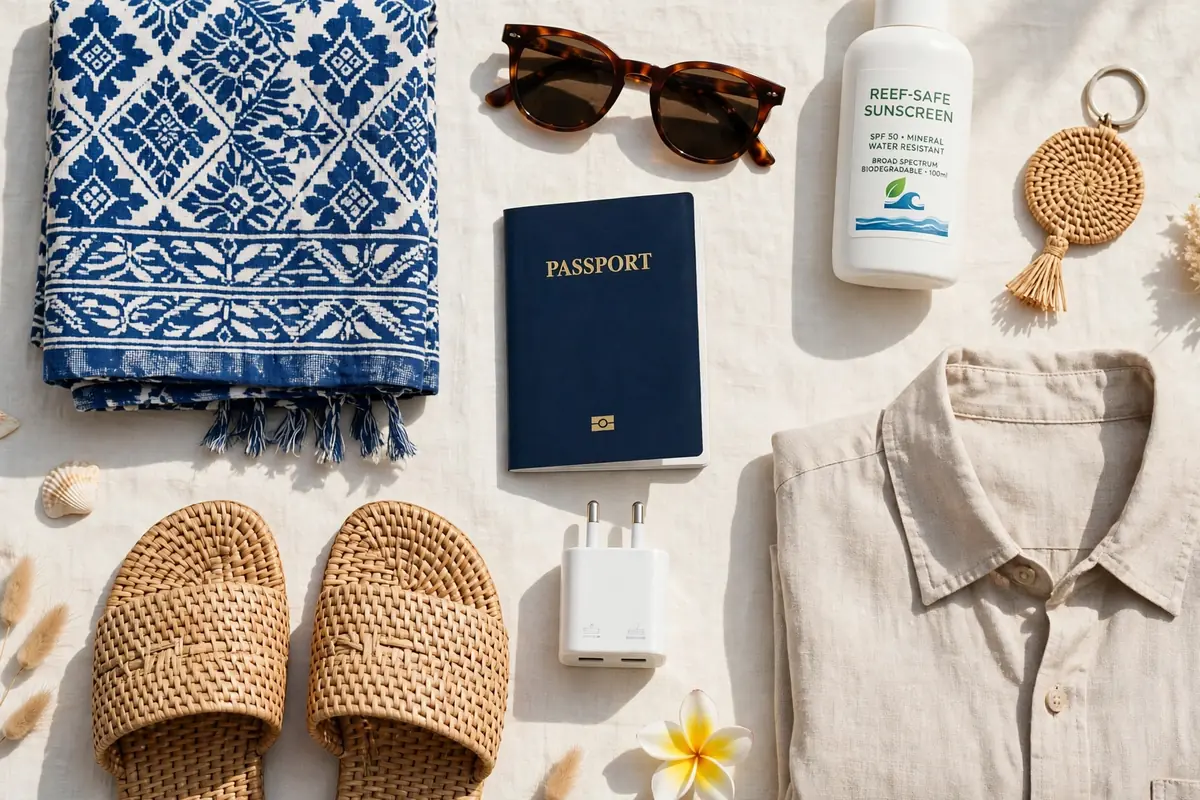
If you are wondering what to pack for Bali, the answer is simpler than most packing lists suggest. Bali sits eight degrees south of the equator, so it is warm all year, around 27 to 32 degrees in the daytime, with a dry season from roughly May to October and a wet season from November to April. You need light, breathable clothes, one modest outfit for temples, reef-safe sunscreen, insect repellent, any medication you rely on, and a plug adapter. Almost everything else, from sarongs and flip-flops to beach clothes and rain ponchos, is cheap and easy to buy on the island.
What actually matters is the small number of items that are hard, expensive or illegal to sort out once you arrive. A forgotten sarong costs a few dollars at a market. A forgotten prescription, the wrong plug, or a banned medicine in your bag can cost you a day, a fine or far worse. This guide covers the essentials in order of importance, starting with documents and ending with what to leave at home, so you can pack a light bag and still be ready for temples, volcanoes, reefs and rain. All rules and figures here are as of November 2026.
What to Pack for Bali: The Short List
Before the detail, here is the short version of what to pack for Bali. Documents: a passport valid for at least six months after arrival, your visa or e-VOA confirmation, your Bali tourist levy receipt, travel insurance details, and booking confirmations saved offline. Clothes: five to seven lightweight outfits in cotton or linen, a sarong, one top that covers your shoulders, a light rain jacket in the wet season, and a warm layer for the highlands. Health: reef-safe sunscreen SPF 50, insect repellent with DEET or picaridin, oral rehydration salts, and your personal medication in its original packaging with a prescription. Tech: a Type C or F plug adapter, a power bank, and a waterproof phone pouch. That is the core of the list. Everything below explains why each item is on it, and what happens if you leave it behind.
Documents and Arrival Paperwork
Start with paperwork, because Bali’s arrival process now involves several steps that are all done online before you fly. Your passport must be valid for at least six months after your arrival date, and you need a return or onward ticket, which airlines may check at check-in. Most visitors need a visa on arrival or an e-VOA, which costs 500,000 Indonesian rupiah for 30 days and can be extended once for another 30 days. The e-VOA is applied for in advance at the official immigration portal, evisa.imigrasi.go.id, and it must be used within 90 days of issue. One application can cover up to five people. A small number of nationalities are visa-exempt for 30 days, so check your own passport’s position on the official portal before you travel. For the latest official guidance, including on medicines and entry rules, read Smartraveller’s travel advice for Indonesia before you pack.
On top of the visa, every foreign visitor to Bali pays a tourist levy of 150,000 rupiah per person, once per trip, through the Bali provincial government’s Love Bali system. Payment is cashless, by card, bank transfer or QR code, and produces a QR voucher to keep on your phone. Since 1 October 2025, every passenger arriving in Indonesia must also file the free All Indonesia arrival declaration, which combines the immigration, customs, health and quarantine forms into one, within three days before arrival. Keep screenshots and offline copies of all three confirmations, the e-VOA, the levy voucher and the arrival card, because airport Wi-Fi is not something to rely on at immigration. A note on prices: in August 2026 higher visa fees were announced, reported as 750,000 rupiah for an e-VOA and 1,000,000 rupiah on arrival, but no start date was confirmed and the official portal continued to list 500,000 rupiah, so check the portal itself before you pay anything.
Clothes for Heat, Temples and the Highlands
Bali’s heat is the first thing your packing has to handle. The coast stays hot and humid all year, with daytime temperatures around 30 degrees, so pack light, loose clothing in cotton or linen and leave the heavy fabrics at home. Five to seven outfits is enough for a week, since laundry is cheap everywhere, typically around 10,000 rupiah per kilo, and clothes are cheap to buy on the island. Synthetic fabrics feel genuinely uncomfortable in Bali’s humidity, so natural fibres are worth the space. Pack two swimsuits, so one can dry while you wear the other, a hat and sunglasses, and sandals or flip-flops for everyday wear.
Temples are where packing actually matters. To enter almost any Balinese Hindu temple you need a sarong and a sash around your waist, and your shoulders and knees should be covered. Big sites such as Uluwatu, Tirta Empul and Besakih lend or rent sarongs at the gate, usually for a small fee, but owning one is easier and more respectful, and any market sells them cheaply. A lightweight sarong of your own doubles as a beach mat, a sun cover and a modesty layer, and it weighs almost nothing. Pack one top that covers your shoulders and one outfit that covers your knees, and keep slip-on shoes for temple visits, since you will be taking them off at entrances.
The highlands are the exception to Bali’s heat. Ubud nights are cooler than the coast, and a sunrise hike up Mount Batur starts in the dark at around 10 to 15 degrees, so pack a warm layer, a light jacket and closed shoes with grip if you plan to hike. The same warm layer helps on the long, air-conditioned drive to the volcano and in restaurants and malls with strong air conditioning. If you are travelling in the wet season, from November to March, add a packable rain jacket and a dry bag for your phone and documents, since the rain arrives in short, heavy bursts and can soak an unprotected bag in minutes.
Sun, Sea and the Reef
The equatorial sun burns faster than most visitors expect, even on overcast days, and the UV index in Bali regularly reaches 11 in the dry season. Bring reef-safe sunscreen with SPF 50, meaning a mineral formula based on zinc oxide or titanium dioxide, without oxybenzone or octinoxate, which damage coral. This is one of the items worth bringing from home, because imported sunscreen is noticeably pricier in Bali than at home and local stock can be limited outside the tourist hubs. Apply it before you go in the water, not after, and reapply often, since sweat and swimming wash it off faster than you think.
For the sea, pack a rash guard or UV shirt, which protects your shoulders far better than sunscreen alone during a long snorkelling session, and reef or water shoes for rocky beaches and waterfall pools. A snorkel mask of your own is worth the space if you plan to snorkel more than once, since rental masks often leak. A quick-dry microfibre towel is lighter and dries faster than a hotel towel, and a reusable water bottle helps you avoid single-use plastic, which Bali’s provincial government has been targeting with a 2025 circular restricting small single-use plastic bottles. Refill stations are increasingly common in cafes, hotels and co-working spaces.
Tech and Power: Plugs, Adapters and Connectivity
Indonesia runs on 230 volts at 50 hertz and uses the two-pin European Type C and Type F sockets. Visitors from the UK, the US, Australia and many other countries need an adapter, so pack one before you fly, or buy one at any minimarket on arrival. A small multi-USB charger is more useful than a stack of single chargers, and a power bank is essential for long days out, since navigation, photos and ride-hailing drain a phone quickly and there are not always places to charge.
Make sure your phone is unlocked and eSIM-ready before you travel, so you can buy a local eSIM or a tourist SIM at the airport. Download the apps you will need before you leave: Grab for rides and food delivery, Google Maps with offline maps of Bali saved, and WhatsApp, which is how most drivers, hotels and tour operators in Bali communicate. A waterproof phone pouch is cheap insurance for boat trips and waterfall visits, and a headlamp is worth packing if you plan the Mount Batur sunrise hike, since the climb starts in darkness. Pack all chargers and cables in your carry-on, not your checked bag, so a delayed suitcase does not leave you with a dead phone.
Health and Medicines: Read This Before You Pack
This is the most important section in this guide, because Indonesia’s drug laws are among the strictest in the world and a mistake here is not a minor inconvenience. Ordinary prescription medicines may be brought in for personal use, generally up to a 90-day supply, in their original packaging, with a prescription or doctor’s letter showing your name, the active ingredient rather than just the brand name, the dose and the diagnosis. Keep medicines in your hand luggage, not your checked bag, and declare them truthfully on the All Indonesia arrival card, which now includes the customs declaration.
Some medicines that are legal at home are illegal in Indonesia, even with a prescription, and this is where travellers get caught out. Amphetamine-based ADHD drugs such as Adderall, Dexedrine and Vyvanse are Class I narcotics in Indonesia, and Australia’s Smartraveller site states plainly that a prescription does not make them legal. Do not bring them. Methylphenidate, sold as Ritalin or Concerta, is a different case: it is listed as a Class II psychotropic, so foreign nationals may carry it for personal use with a prescription and in limited quantities, generally up to 60 days’ supply. Because the rules are detailed and the categories change, check the active ingredient of any ADHD medicine with the Indonesian embassy in your country before you pack it, and talk to your doctor well in advance about a legal substitute that can be prescribed by a clinic in Bali if needed.
Cannabis, CBD, hemp and THC products in any form are illegal in Indonesia, even if they are legal at home and even with a medical prescription from another country. Do not bring CBD oil, gummies, creams or vape products, and do not mail medicines to Indonesia, since psychotropics and narcotics cannot be sent by post or courier. Codeine products, including some cough syrups and combination painkillers, and strong opioids such as morphine and oxycodone are also banned from being brought in. Drug offences in Indonesia can lead to arrest, prison, fines, deportation or the death penalty, so this is not a rule to test. For the current official position, read Smartraveller’s travel advice for Indonesia before you travel, and check your own government’s advice too.
Your health kit should also include insect repellent with DEET or picaridin, since dengue fever is present year-round and peaks in the wet season, oral rehydration salts and an anti-diarrhoeal medicine for stomach upsets, a small first-aid kit, motion sickness tablets for fast boats, and hand sanitiser. Pack sunscreen and repellent in your carry-on in travel sizes, and put larger bottles in your checked bag. Travel insurance is not optional for Bali: make sure it covers scooter accidents, which are the most common serious injury for visitors, and medical evacuation, and keep the policy number and emergency number saved offline on your phone.
Shoes, Beach and Adventure Gear
Shoes deserve more thought than most packing lists give them. You need three pairs at most: comfortable walking sandals or broken-in trainers for towns and temples, flip-flops for the beach and for slipping off at temple entrances, and trail shoes with grip if you plan to hike a volcano or chase waterfalls. Water shoes are useful for reef and rocky beaches, where coral and sharp rock can cut bare feet. Do not bring brand-new shoes to Bali: break them in at home, because blisters in tropical heat heal slowly and can ruin several days of a trip.
For adventure days, a small daypack is more useful than a large bag. It should hold water, sunscreen, a rain jacket, your phone pouch and a dry bag for electronics. A dry bag is cheap and protects your camera and passport on boat trips and in waterfall pools. If you plan to surf, bring your own rash guard and reef booties for the Bukit peninsula’s reef breaks, and check whether your accommodation or surf school provides boards, since carrying your own is rarely worth it. A sarong, again, is the most versatile item you will pack: beach towel, temple wear, sun shade, blanket on a cold bus, and a cover-up for a restaurant that expects more than swimwear.
Money, Transport and Staying Safe
Pack for Bali’s money system, which is still largely cash at street level. Bring a debit card that does not charge high foreign withdrawal fees and a credit card as a backup, and keep them in separate places. ATMs are common in tourist areas but charge a withdrawal fee, so taking out larger amounts less often saves money. Carry small notes, since markets, food stalls and drivers often cannot change a large note. Use authorised ATMs inside banks or shops, never let your card out of your sight, and tell your bank you are travelling before you leave so your card is not blocked on the first withdrawal.
For transport, pack an International Driving Permit with the right category in addition to your national licence if you plan to ride a scooter. This is a legal requirement, not a suggestion, and travel insurance may not cover you without one. Scooter accidents are the most common serious injury for visitors to Bali, so ride only if you are experienced and properly licensed, wear a helmet, and never ride after drinking. For most travellers, a private driver hired by the day, or ride-hailing through Grab, is cheaper and far safer than a scooter. Keep your passport or a photo of it with you, since immigration spot checks happen in tourist areas, and keep your bag on the side away from the road when walking, since bag and phone snatching from passing motorbikes happens in busy areas.
What to Leave at Home, and What to Buy There
Packing light is a skill, and Bali is the easiest place in the world to practise it. Leave heavy guidebooks at home and use your phone instead. Leave expensive jewellery and anything you would be upset to lose, since Bali is relaxed and you will not need it. Leave more than a week’s worth of clothes, since laundry is cheap and fast. Leave full-size toiletries, since most are available in Bali, and leave a hairdryer, since most hotels provide one.
Buy these things in Bali instead of packing them: sarongs, flip-flops, beach clothes, ponchos, hats, sunscreen top-ups, insect repellent and local SIM cards. Bali’s markets and small-brand fashion scene are genuinely good, and prices at village markets beat anything at your local mall. What you should not rely on buying locally is reef-safe sunscreen in the brand you trust, any prescription medicine, and a good plug adapter in a remote area, so bring those from home. A travel journal is worth packing too: Bali is the kind of trip you will want to remember in detail, and our guide to how to start a journal and our journaling prompts for beginners will help you keep one. Before you plan the rest of your route, it is also worth checking the entry rules for any other country on your trip, as our guide to whether US citizens need a visa for Albania shows how much those rules can vary.
Packing by Trip Length and Season
For a short trip of three to five days, a carry-on bag is enough. Pack three or four outfits, one sarong, one modest temple outfit, two swimsuits, your documents, sunscreen, repellent, an adapter and your medicines. For a trip of one to two weeks, add a few more outfits, a warm layer for the highlands, trail shoes, and a daypack, and plan to do laundry halfway through. For a month or longer, pack the same as for two weeks and buy what you need locally, since you will be doing laundry regularly and your bag will only get heavier if you over-pack at the start.
In the dry season, from May to October, you can leave the rain jacket at home, though a light waterproof layer is still useful for boat trips and waterfall spray. In the wet season, from November to March, the rain jacket and dry bag become essential, and quick-dry clothes matter more than cotton, since humidity makes cotton slow to dry. If your trip covers Nyepi, the Day of Silence on Monday 8 March 2027, pack extra snacks, water and entertainment for the 24 hours you will spend inside your accommodation, since shops, restaurants and delivery apps all stop. And whatever the season, pack patience: Bali rewards travellers who slow down, and a light bag makes slowing down much easier.
Frequently Asked Questions
What to pack for Bali for a first trip?
What to pack for Bali on a first trip is light, breathable clothes, a sarong and a modest outfit for temples, reef-safe sunscreen SPF 50, insect repellent, a Type C or F plug adapter, your passport and visa documents, and any personal medication in its original packaging with a prescription. Buy sarongs, flip-flops and beach clothes cheaply on the island.
Do I need a plug adapter for Bali?
Yes, if you are travelling from the UK, the US, Australia or most countries outside continental Europe. Indonesia uses 230 volts at 50 hertz with Type C and Type F two-pin sockets. Pack a Type C or F adapter before you fly, or buy one at any minimarket on arrival.
What should I wear to visit temples in Bali?
Shoulders and knees covered, plus a sarong and a sash tied at the waist. Major temples such as Tanah Lot and Uluwatu lend or rent sarongs at the entrance, so you do not strictly need your own, but a lightweight sarong of your own doubles as a beach mat and a sun cover and costs little at any local market.
Can I bring my prescription medication to Bali?
Ordinary prescription medicines are allowed for personal use, up to a 90-day supply, in original packaging with a prescription showing the active ingredient. Amphetamine-based ADHD drugs such as Adderall and Vyvanse are banned even with a prescription, and CBD and cannabis products are illegal in any form. Check the active ingredient with the Indonesian embassy before you travel.
Is reef-safe sunscreen necessary in Bali?
Yes, for snorkelling and swimming over reefs. Reef-safe sunscreen uses mineral filters such as zinc oxide or titanium dioxide, without oxybenzone or octinoxate, which damage coral. Bring it from home, since imported sunscreen is pricier in Bali and local stock can be limited outside tourist areas.
What should I not pack for Bali?
Do not pack CBD or cannabis products, amphetamine-based ADHD medication, heavy clothes, expensive jewellery, or more than a week’s worth of outfits. Leave heavy guidebooks and full-size toiletries at home, and do not mail medicines to Indonesia, since that route is not permitted for controlled medicines.